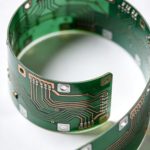
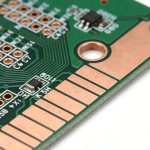
Manufacturing Flexible PCBs (FPC) is significantly more challenging than standard rigid boards. Because the substrate—typically Polyimide (PI)—is thin and mechanically unstable, even minor process fluctuations can lead to dimensional shifts, trace fractures, or delamination.
For engineers and procurement teams, Yield Optimization is the single most effective way to reduce the high “cost-per-unit” associated with flex circuits. Here is how Hansphere approaches high-yield FPC production.
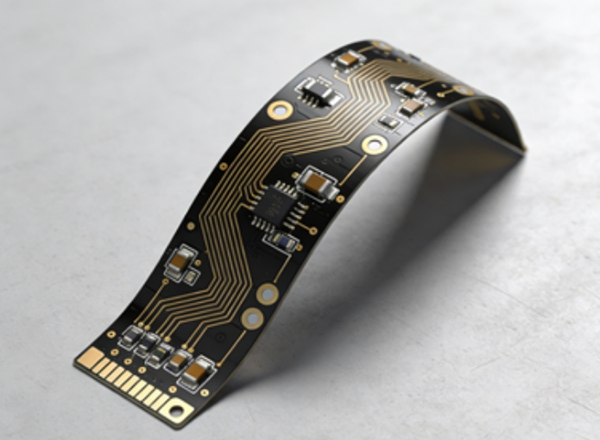
1. The Core Challenge: Dimensional Stability
Unlike FR-4, Polyimide absorbs moisture and shrinks/expands during thermal cycles (lamination and soldering). This “material movement” is the #1 enemy of registration accuracy.
- Expert Strategy: Use Advanced Scaling Factors. Experienced manufacturers apply a non-linear compensation factor to the photolithography artwork to anticipate material shrinkage.
- Pro Tip: Opt for Adhesiveless Base Materials. Adhesiveless PI offers superior dimensional stability and a lower profile than traditional adhesive-based laminates, directly improving yield for HDI-PCB flex designs.
2. DFM Best Practices for Flex Yield
Transition Zone Management
The point where a flex circuit meets a Rigid PCB or a stiffener is a “stress riser.” Without proper design, traces will crack here during bending.
- The Solution: Implement Teardrops on all pads and use Gradual Trace Width Transitions.
- The “Radiused” Rule: Avoid sharp 90-degree corners in the board outline. Use a minimum radius of 1.5mm to prevent edge tearing.
Copper Features & Etching
- I-Beam Effect: Never stack traces directly on top of each other in double-sided flex boards if the board will be folded. Staggering the traces reduces mechanical stress on the copper.
- Cross-Hatching: For large ground planes, use a Cross-hatch pattern instead of solid copper. This maintains flexibility and prevents the “bimetallic strip” effect that causes curling.
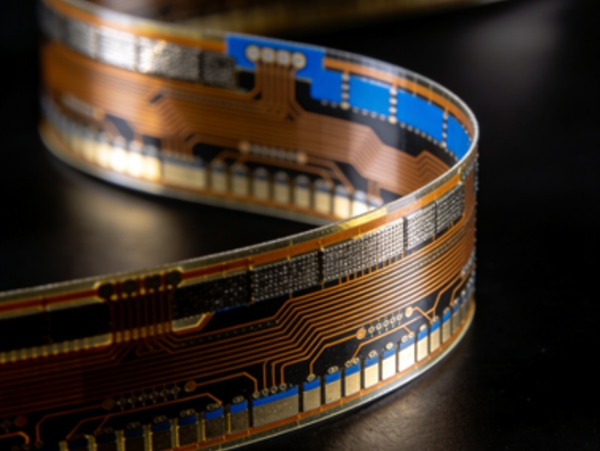
5 Steps to Optimize Your Flex PCB Yield
Target: Design Engineers & Quality Managers
Goal: Minimizing Scrap Rates during Mass Production
- Step 1: Optimize Panel Utilization
Flex materials are expensive. Work with your PCB Manufacturing partner to nest your designs efficiently on the production panel. Even a 5% improvement in nesting can save thousands in material costs.
- Step 2: Select the Right Stiffener
Whether using FR-4, Polyimide, or Stainless Steel stiffeners, the alignment is critical.
Hansphere Strategy: We use automated optical alignment for stiffener lamination to ensure that the transition from flex to rigid remains stress-free. - Step 3: Implement “Pads-Only” Coverlay Openings
Avoid large, gang-style coverlay openings. Individual openings for each pad provide better sealing and prevent chemistry entrapment during PCB Assembly, which otherwise leads to long-term corrosion.
- Step 4: Control the Bending Radius
Ensure your design respects the Minimum Bend Radius (typically 6x-10x the thickness for static flex, and 20x+ for dynamic flex). Exceeding this limit is the fastest way to drop your yield to zero.
- Step 5: Advanced Electrical Testing
In High Frequency PCBs
that are flexible, standard continuity tests aren’t enough. Use Flying Probe Testing with low-pressure tips to avoid damaging the soft PI surface.
3. Why Material Handling Matters
Yield is won or lost on the shop floor. Because flex boards are so thin, they are prone to “handling damage” (kinks and scratches).
- Hansphere’s Approach: We utilize specialized Vacuum Handling Frames and interleaving sheets throughout the production line to ensure no mechanical stress is applied to the bare circuits.
- Learn More: Discover our specialized Flex-PCB and Rigid-Flex PCB capabilities.

Flexible PCB Manufacturing & Yield FAQ
A: This is usually due to unbalanced copper distribution or moisture absorption in the PI. Pre-baking the boards at $120$°C for 2-4 hours before assembly can significantly reduce warping and delamination.
A: Absolutely not. Vias and plated holes are rigid structures. Placing them in a bend area will cause the plating to crack almost immediately. Always move vias to a “neutral” or stiffened zone.
A: We perform a comprehensive Pre-CAM DFM review. Our engineers analyze your PCB Design for potential stress points and suggest modifications before we start the first production run.
Conclusion
Optimizing yield in Flexible PCB manufacturing isn’t just about better machines—it’s about a deep partnership between the designer and the fabricator. By respecting the mechanical limits of Polyimide and implementing DFM-aware routing, you can achieve stable, cost-effective production for even the most complex applications.
Looking to scale your Flex PCB production? At Hansphere, we specialize in high-yield manufacturing for medical, aerospace, and consumer electronics. Contact our technical team today for a yield-optimization consultation.