Copper is the conductive foundation of every printed circuit board. While designers often focus on trace width or layer count, the thickness of the copper is just as important.
In PCB manufacturing, copper thickness is usually specified by copper weight rather than by microns or millimeters. This specification affects current capacity, heat dissipation, manufacturing processes, and overall board cost.
What Is PCB Copper Weight?
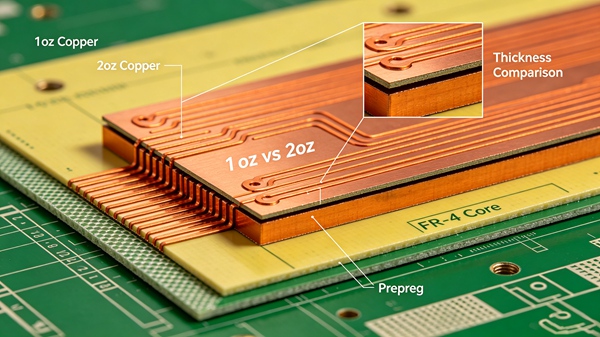
Copper weight describes the thickness of the copper foil laminated onto the PCB.
The unit “ounce” refers to the weight of copper spread evenly over one square foot of area.
For example:
| Copper Weight | Approximate Thickness |
|---|---|
| 0.5 oz | 17 μm |
| 1 oz | 35 μm |
| 2 oz | 70 μm |
| 3 oz | 105 μm |
| 4 oz | 140 μm |
Although copper weight is measured in ounces, it is commonly used as a thickness specification in PCB fabrication.
If you’re unfamiliar with the copper layer itself, see PCB Copper Foil Types and Their Applications before choosing a copper specification.
Why Copper Weight Matters
Copper weight affects much more than the appearance of a PCB.
It influences:
- Current carrying capacity
- Trace width requirements
- Heat distribution
- Manufacturing difficulty
- Finished board cost
Selecting the wrong copper thickness can lead to unnecessary manufacturing expense or reduced electrical performance.
Standard Copper Weight
1 oz copper is the most common choice for commercial electronics.
It provides a practical balance between electrical performance, manufacturability, and cost.
Typical applications include:
- Consumer electronics
- Industrial control boards
- Communication equipment
- Medical devices
- General-purpose multilayer PCBs
For most products, 1 oz copper meets both electrical and manufacturing requirements.
Heavy Copper PCB
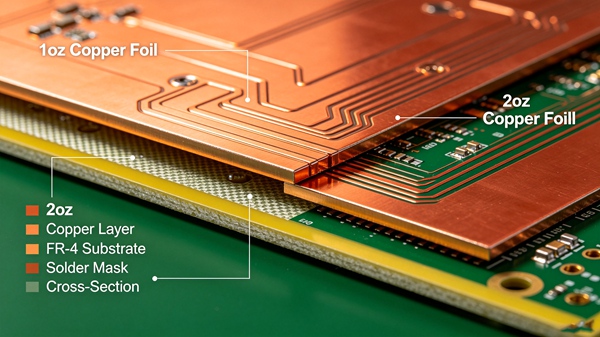
Applications with higher current demand often require thicker copper.
Common heavy copper options include:
- 2 oz
- 3 oz
- 4 oz
- 6 oz and above
Heavy copper is frequently used in:
- Power supplies
- Battery management systems
- Motor controllers
- Industrial automation
- Power conversion equipment
Thicker copper helps reduce resistive losses and allows traces to carry more current without excessive temperature rise.
How Copper Weight Affects PCB Design
Trace Width
As current increases, traces generally need to become wider or use thicker copper.
Using heavier copper can reduce the trace width required for the same current level, which is especially useful when board space is limited.
Thermal Performance
Copper also spreads heat across the PCB.
While FR4 provides structural support, the copper planes play an important role in transferring heat away from components.
If thermal management is a concern, you may also find FR4 Thermal Conductivity in PCB Design Explained useful.
Manufacturing Complexity
Increasing copper thickness changes several fabrication processes.
Heavier copper may require:
- Longer etching times
- Larger minimum trace widths
- Larger spacing between traces
- Different plating parameters
For this reason, heavy copper designs should be reviewed with the PCB manufacturer during the design stage.
Cost
Thicker copper increases material consumption and usually requires additional manufacturing control.
As a result, boards with heavy copper are typically more expensive than standard 1 oz designs.
However, using thicker copper where it is genuinely needed can improve reliability and reduce operating temperatures.
Choosing the Right Copper Weight
There is no universal copper thickness for every PCB.
Selection depends on several factors:
- Operating current
- Temperature rise limits
- Available routing space
- PCB layer count
- Manufacturing budget
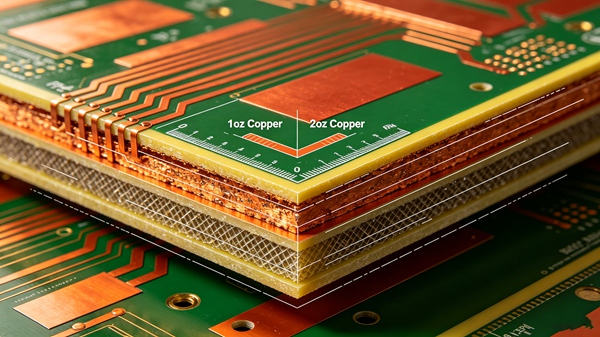
Many designs use different copper weights on different layers. For example, outer layers may use 2 oz copper for power distribution, while inner signal layers remain at 1 oz.
Copper Weight and Multilayer PCBs
Copper weight becomes increasingly important as the layer count increases.
Stackup design, dielectric spacing, and impedance control all need to be considered together.
If you’re planning a multilayer design, it’s worth reviewing FR4 PCB Stackup Design Guide to understand how copper thickness fits into the overall layer structure.
Common Mistakes
One common misconception is that thicker copper always results in a better PCB.
In reality, excessive copper thickness can make fine-line routing more difficult and increase manufacturing costs.
Another mistake is choosing copper weight without considering heat generation or current requirements. A balanced design is usually more effective than simply selecting the thickest available copper.
How to Choose PCB Copper Weight
- Step 1
Estimate the maximum current that each circuit will carry.
- Step 2
Determine the allowable temperature rise for the application.
- Step 3
Review available routing space and layer count.
- Step 4
Confirm the copper weight with your PCB manufacturer before finalizing the stackup.
Conclusion
Copper weight is a key specification that affects electrical performance, thermal management, manufacturability, and cost.
For many commercial products, 1 oz copper remains the standard choice. Higher current applications may benefit from heavier copper, but the decision should always be based on the actual electrical and mechanical requirements of the design.
Choosing the right copper weight early in the project helps improve manufacturing efficiency and long-term product reliability.
Frequently Asked Questions
A: It means one ounce of copper is distributed over one square foot of board area, producing a copper thickness of approximately 35 μm.
A: Not necessarily. Two-ounce copper carries more current, but it also increases manufacturing complexity and cost. The best choice depends on the application.
A: Yes. Heavier copper increases raw material usage and often requires more demanding fabrication processes, resulting in a higher manufacturing cost.
A: Yes. Many multilayer PCBs use heavier copper on power layers and standard copper on signal layers.
A: Consider current requirements, acceptable temperature rise, available routing space, and manufacturing capability. Discuss these requirements with your PCB manufacturer before production.