Heat is one of the most important factors affecting PCB reliability.
Every electronic component generates heat during operation, and that heat must be transferred away from sensitive areas to maintain stable performance.
The PCB substrate plays a role in this process, but not all materials behave the same way.
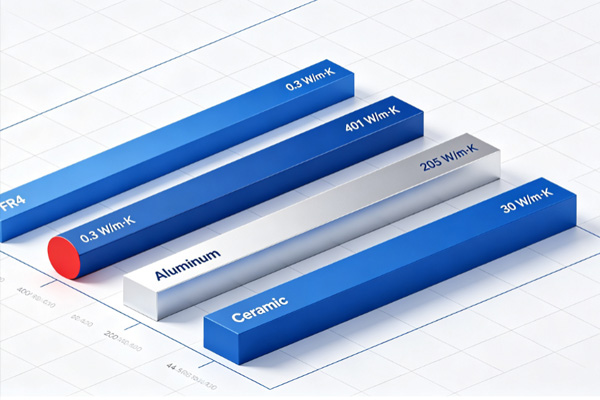
FR4, the most commonly used PCB material, has relatively low thermal conductivity compared with metal-based or ceramic substrates. This characteristic directly influences how heat spreads across the board.
What Thermal Conductivity Means
Thermal conductivity describes how easily heat moves through a material.
In PCB materials, it determines how quickly heat generated by components can spread from one area to another.
FR4 is a fiberglass-reinforced epoxy material, and both components have limited ability to conduct heat.
As a result, FR4 does not efficiently transfer heat away from hot spots.
Typical Thermal Conductivity of FR4
Standard FR4 materials typically have thermal conductivity around:
0.25 – 0.35 W/m·K
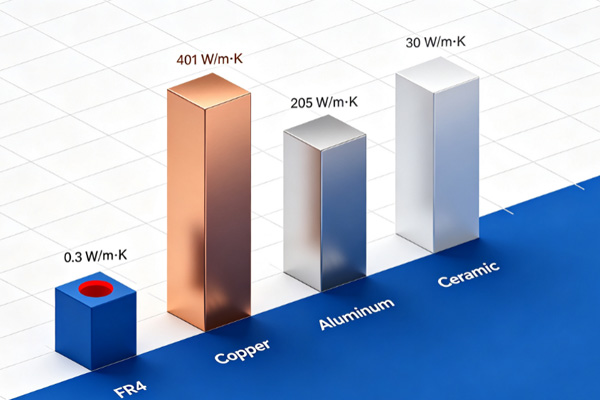
This is considered low compared with other PCB materials such as:
- Aluminum substrate PCBs
- Ceramic PCBs
- Copper-based heat spreaders
The low thermal conductivity is one of the key limitations of FR4 in high-power applications.
Why FR4 Has Low Thermal Conductivity
The internal structure of FR4 explains its thermal behavior.
It consists of:
- epoxy resin (low heat conduction)
- woven fiberglass (moderate insulation structure)
- copper layers (high conductivity but separated by dielectric layers)
Heat does not move efficiently through the epoxy-glass structure, so it tends to remain localized around heat sources.
How Thermal Conductivity Affects PCB Performance
Localized Heating
Because heat spreads slowly, temperature can rise significantly near high-power components.
This may create thermal stress in specific areas of the PCB.
Component Reliability
Electronic components are sensitive to temperature.
Higher localized temperatures can reduce long-term reliability and accelerate aging.
Temperature Gradient Across the Board
Uneven heat distribution can create thermal gradients, which may lead to mechanical stress over time.
This is especially relevant in larger or high-power boards.
FR4 vs High Thermal Conductivity Materials
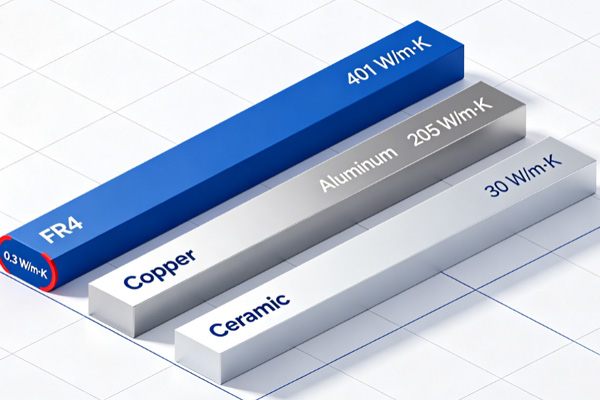
FR4 is not designed for high heat transfer applications.
Other materials provide better thermal performance:
- Aluminum core PCBs
- Copper coin PCBs
- Ceramic substrates
These materials are often used in LED lighting, power modules, and automotive electronics.
However, FR4 remains widely used because of its cost efficiency and mechanical stability.
How Designers Work Around FR4 Limitations
Since FR4 has low thermal conductivity, engineers typically manage heat using PCB design techniques rather than changing material.
Common approaches include:
- increasing copper area for heat spreading
- using thermal vias
- distributing heat-generating components
- optimizing component placement
Related reading: FR4 Material Properties That Affect PCB Performance
When FR4 Thermal Conductivity Is Not a Problem
FR4 performs well in many applications where heat generation is moderate.
Typical examples include:
- consumer electronics
- communication devices
- low to medium power industrial systems
In these cases, the material’s thermal limitation does not significantly impact reliability.
When FR4 Becomes a Limitation
Thermal conductivity becomes critical when:
- power density is high
- components generate continuous heat
- compact layouts concentrate heat sources
- long-term thermal stress is expected
In these scenarios, alternative materials may be considered.
Relationship Between Thermal Conductivity and Reliability
Thermal performance is directly linked to reliability.
Poor heat dissipation can accelerate:
- dielectric aging
- copper fatigue
- solder joint stress
However, thermal conductivity is only one factor among many affecting PCB reliability.
Related reading: FR4 Moisture Absorption and Its Impact on PCB Reliability
Conclusion
FR4 has relatively low thermal conductivity, which limits its ability to dissipate heat efficiently across the PCB.
However, its combination of cost efficiency, mechanical strength, and manufacturability ensures it remains the most widely used PCB material.
In most applications, thermal management is achieved through design techniques rather than changing substrate materials.
For high-power or high-density designs, material selection becomes more critical and may require alternatives with higher thermal conductivity.
How to Evaluate Thermal Requirements in PCB Materials
- Step 1
Estimate total heat generated by components.
- Step 2
Identify high-temperature zones on the PCB layout.
- Step 3
Evaluate whether FR4 thermal performance is sufficient.
- Step 4
Consider alternative materials only if necessary for reliability.
Frequently Asked Questions
A: No. FR4 has relatively low thermal conductivity compared with metal or ceramic PCB materials.
A: Because it is made of epoxy resin and fiberglass, both of which are poor heat conductors.
A: Yes, but thermal management must be carefully designed using copper planes, vias, and layout optimization.
A: Aluminum-based PCBs, copper-core boards, and ceramic substrates provide significantly better thermal performance.
A: Yes. Poor heat dissipation can increase component temperature and reduce long-term reliability.