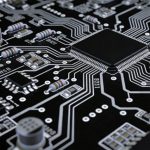
FR4 is the most widely used PCB substrate, but it is not the only option available.
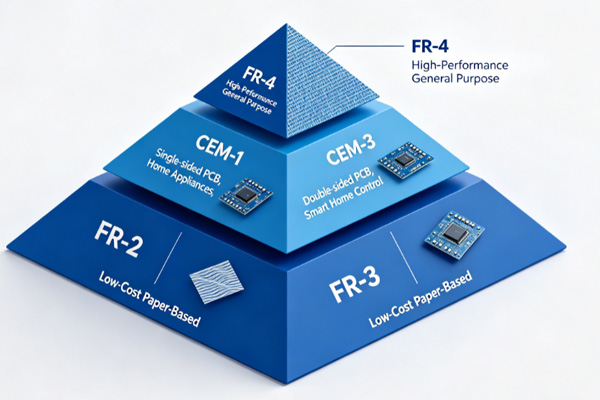
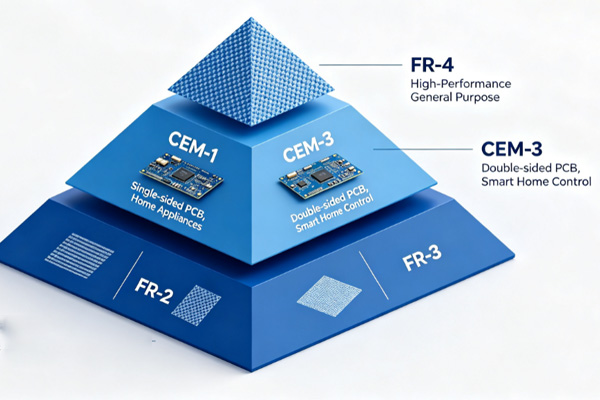
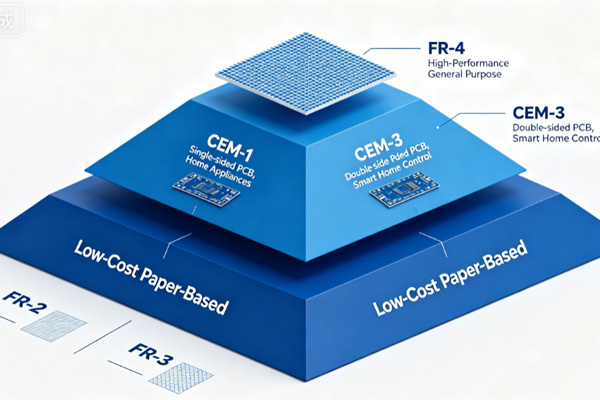
For products where cost, manufacturing requirements, or application demands differ, composite epoxy materials such as CEM-1 and CEM-3 are also used.
Although both belong to the CEM (Composite Epoxy Material) family, they differ in construction, mechanical properties, and manufacturing characteristics.
What Are CEM PCB Materials?
CEM stands for Composite Epoxy Material.
Like FR4, CEM materials use epoxy resin as the insulating matrix. The main difference lies in the reinforcing material used inside the laminate.
Different reinforcement structures create different mechanical and electrical characteristics.
Among the available grades, CEM-1 and CEM-3 are the most commonly used in PCB manufacturing.
What Is CEM-1?
CEM-1 combines a paper core with layers of woven fiberglass on the outer surfaces.
This construction provides better mechanical strength than paper-based laminates while keeping manufacturing costs relatively low.
Typical characteristics include:
- good electrical insulation
- relatively low material cost
- suitable for single-sided PCBs
- limited support for plated through holes
Because of its structure, CEM-1 is mainly used for simple circuit boards.
What Is CEM-3?
CEM-3 is manufactured using fiberglass reinforcement throughout the laminate, giving it a structure that is more similar to FR4.
Compared with CEM-1, it offers:
- improved mechanical strength
- better dimensional stability
- smoother surface finish
- compatibility with double-sided PCB manufacturing
- improved drilling quality
Its appearance is often lighter in color than standard FR4.
Mechanical Performance
Mechanical strength influences machining quality and long-term durability.
CEM-3 generally provides better rigidity and dimensional stability than CEM-1.
This makes it more suitable for products that require tighter manufacturing tolerances or repeated assembly operations.
Electrical Performance
Both materials provide adequate electrical insulation for many low- and medium-frequency applications.
However, FR4 generally offers more consistent electrical properties, particularly in multilayer or high-speed PCB designs.
For products with modest electrical requirements, both CEM materials remain practical options.
Related reading:
- What Is FR4 PCB Material
- FR4 Material Properties That Affect PCB Performance
Manufacturing Characteristics
The construction of the laminate affects fabrication.
CEM-1
CEM-1 is commonly used for:
- single-sided PCBs
- simple consumer products
- low-cost electronic devices
Its paper core limits its suitability for more complex board structures.
CEM-3
CEM-3 supports:
- double-sided boards
- plated through holes
- higher assembly quality
- more stable manufacturing processes
For these reasons, it is often selected when improved reliability is required without moving to full FR4.
Typical Applications
CEM-1
Common applications include:
- household appliances
- toys
- simple power supplies
- low-cost control boards
CEM-3
Typical applications include:
- LED lighting products
- consumer electronics
- office equipment
- communication accessories
Products requiring multilayer construction generally move to FR4 rather than CEM materials.
Cost Considerations
Material cost is one reason CEM laminates continue to be used.
In general:
- CEM-1 is less expensive than CEM-3.
- CEM-3 is typically more affordable than standard FR4 while offering improved performance over CEM-1.
The overall manufacturing cost also depends on board complexity, production volume, and processing requirements.
Choosing Between CEM-1, CEM-3, and FR4
Material selection should consider more than price alone.
Questions to evaluate include:
- Is the board single-sided or double-sided?
- Are plated through holes required?
- What level of mechanical strength is needed?
- What operating environment will the product face?
- Is long-term reliability a priority?
For many simple products, CEM materials provide sufficient performance.
For multilayer, high-density, or thermally demanding designs, FR4 remains the preferred choice.
How to Select the Right PCB Material
- Step 1
Determine the board structure, including the number of layers and whether plated through holes are required.
- Step 2
Review the electrical and mechanical requirements of the application.
- Step 3
Compare material cost with expected product lifetime and reliability.
- Step 4
Confirm material availability and manufacturing capabilities with your PCB supplier.
Conclusion
CEM-1 and CEM-3 remain valuable PCB materials for many cost-sensitive applications.
CEM-1 is generally suited to simple single-sided boards, while CEM-3 offers improved mechanical performance and supports more advanced PCB constructions.
Selecting the appropriate material depends on balancing performance, manufacturing requirements, and overall product cost rather than choosing the lowest-priced laminate.
Frequently Asked Questions
A: CEM stands for Composite Epoxy Material, a family of PCB laminates made from epoxy resin and reinforcing materials.
A: CEM-1 uses a paper core with fiberglass outer layers and is mainly used for single-sided boards. CEM-3 uses fiberglass reinforcement throughout the laminate and supports more complex PCB designs.
A: No. CEM-3 has some characteristics similar to FR4 but generally offers lower mechanical and thermal performance.
A: CEM-1 is suitable for low-cost, single-sided electronic products with simple circuit requirements.
A: Not necessarily. For simple, cost-sensitive applications, CEM materials may provide sufficient performance at a lower cost, while FR4 is preferred for higher-performance or multilayer PCBs.