FR4 is the most common material used to manufacture printed circuit boards. From consumer electronics and industrial controllers to communication equipment and medical devices, millions of PCBs are built on FR4 every year.
Its popularity comes from a balanced combination of electrical performance, mechanical strength, thermal stability, and manufacturing cost. While many specialized PCB materials are available today, FR4 remains the first choice for most standard applications.
What Does FR4 Mean?
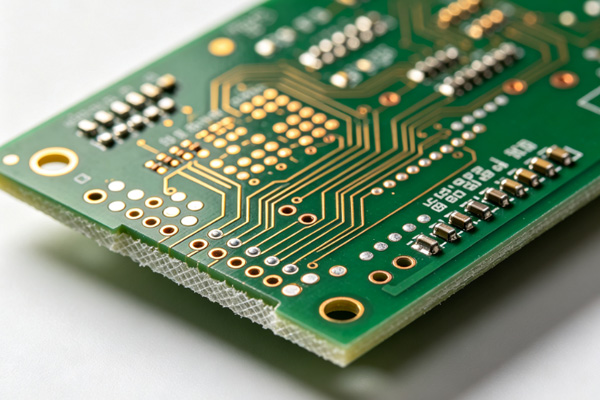
FR4 stands for Flame Retardant 4.
The “FR” indicates that the material meets specific flame-retardant requirements, while the number “4” identifies the grade within the NEMA (National Electrical Manufacturers Association) classification system.
FR4 is not the name of a single manufacturer’s product. Instead, it refers to a category of fiberglass-reinforced epoxy laminates that meet similar performance standards.
Although different laminate manufacturers use different resin formulations and fiberglass styles, most FR4 materials share similar characteristics.
What Is FR4 Made Of?
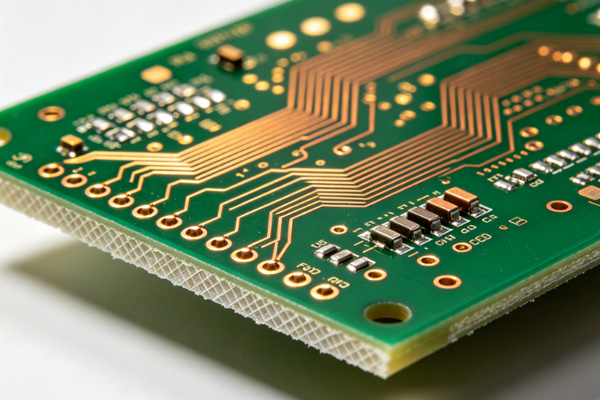
FR4 is a composite material consisting of two primary components.
Fiberglass Cloth
Woven fiberglass provides mechanical strength and dimensional stability.
It helps the PCB maintain its shape during drilling, assembly, and long-term operation.
Epoxy Resin
The epoxy resin bonds the fiberglass layers together and provides electrical insulation.
It also contributes to moisture resistance and flame-retardant performance.
After the fiberglass is impregnated with epoxy resin and cured under heat and pressure, the result is a rigid laminate suitable for PCB fabrication.
Copper foil is then laminated onto one or both sides of the substrate to create the conductive layers used in printed circuit boards.
Why FR4 Is the Most Common PCB Material
FR4 has remained the industry standard because it performs well across a wide range of applications.
Its main advantages include:
- Good electrical insulation
- High mechanical strength
- Stable dimensions during manufacturing
- Reliable thermal performance for most applications
- Good moisture resistance
- Broad compatibility with PCB fabrication processes
- Competitive material cost
Rather than excelling in only one area, FR4 offers a practical balance of performance and affordability.
Typical Properties of FR4
Although specifications vary between laminate manufacturers, standard FR4 generally provides the following characteristics.
| Property | Typical Value |
|---|---|
| Dielectric Constant (Dk) | 4.2–4.8 |
| Thermal Conductivity | 0.25–0.35 W/m·K |
| Glass Transition Temperature (Tg) | Approximately 130–170°C |
| Flame Rating | UL94 V-0 |
| Moisture Absorption | Approximately 0.10–0.20% |
These values should be considered typical ranges rather than fixed specifications.
Related reading:
- FR4 Material Properties That Affect PCB Performance
- FR4 Dielectric Constant (Er) vs Frequency Explained
Common Applications of FR4
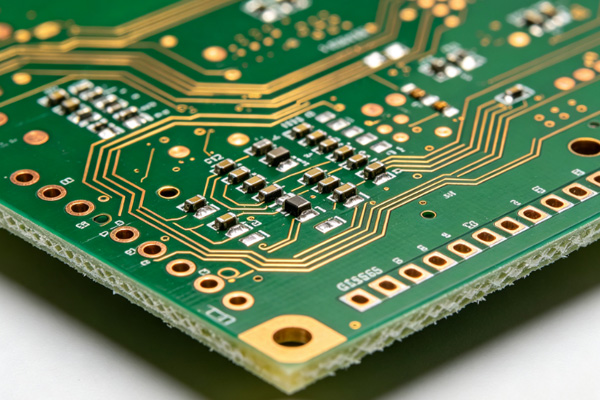
FR4 is suitable for many types of electronic products.
Common applications include:
- Consumer electronics
- Industrial automation
- Medical equipment
- Communication devices
- Power supplies
- Test and measurement equipment
- Security systems
- Smart home products
For these applications, FR4 provides sufficient electrical and mechanical performance without significantly increasing manufacturing cost.
Advantages of FR4 PCB Material
Excellent Cost-to-Performance Balance
One of the biggest reasons for FR4’s popularity is its balance between performance and cost.
For many PCB projects, it delivers all the required characteristics without the need for premium materials.
Reliable Mechanical Strength
Fiberglass reinforcement gives FR4 excellent rigidity.
It resists bending and deformation during manufacturing and assembly.
Good Electrical Insulation
FR4 provides high insulation resistance between conductive layers, making it suitable for single-sided, double-sided, and multilayer PCBs.
Mature Manufacturing Process
Virtually every PCB manufacturer supports FR4 fabrication.
This broad availability helps reduce production lead times and material costs.
Limitations of FR4
Although FR4 is versatile, it is not suitable for every application.
Limited Thermal Conductivity
FR4 transfers heat relatively slowly.
High-power products often require additional thermal management or alternative materials.
Related reading:
FR4 Thermal Conductivity in PCB Design Explained
Not Ideal for High-Frequency Circuits
At microwave and millimeter-wave frequencies, dielectric loss becomes more significant.
Low-loss materials are generally preferred for RF applications.
Related reading:
Temperature Limitations
Standard FR4 performs well under normal operating conditions.
Applications exposed to higher temperatures may require High-Tg laminates for improved thermal stability.
Related reading:
- High-Tg PCB Material for High-Temperature and Reliable PCB Applications
- When Should You Choose High-Tg PCB Material
How FR4 Compares with Other PCB Materials
Compared with specialized materials, FR4 is designed as a general-purpose laminate.
For example:
- Ceramic materials provide much higher thermal conductivity.
- Rogers laminates offer lower dielectric loss for high-frequency circuits.
- High-Tg laminates improve thermal stability for demanding environments.
Each material serves different application requirements.
FR4 remains the preferred option whenever its performance matches the product’s electrical, thermal, and mechanical needs.
Choosing the Right FR4 Material
Not all FR4 laminates are identical.
When selecting a material, consider:
- Operating temperature
- Signal frequency
- Layer count
- Product operating environment
- Reliability requirements
- Manufacturing budget
Matching the material to the application’s actual requirements usually leads to better long-term performance than simply choosing the highest specification.
How to Choose FR4 PCB Material
- Step 1
Define the electrical, thermal, and mechanical requirements of the product.
- Step 2
Determine whether standard FR4 or High-Tg FR4 better matches the operating environment.
- Step 3
Review the PCB layer count, operating frequency, and expected service life.
- Step 4
Confirm the laminate specification with your PCB manufacturer before starting fabrication.
Conclusion
FR4 has become the industry standard because it combines reliable electrical insulation, mechanical strength, thermal stability, and cost-effective manufacturing.
While specialized materials are available for high-frequency, high-power, or high-temperature applications, FR4 continues to provide the best overall balance for most commercial and industrial PCBs.
Selecting the appropriate FR4 grade early in the project helps improve manufacturability, product reliability, and overall production efficiency.
Frequently Asked Questions
A: FR4 is a flame-retardant fiberglass-reinforced epoxy laminate widely used as the base material for printed circuit boards.
A: It offers a balanced combination of electrical insulation, mechanical strength, thermal stability, manufacturability, and cost efficiency.
A: FR4 can be used for many digital circuits, but low-loss materials are generally preferred for microwave and high-frequency RF applications.
A: High-Tg FR4 has a higher glass transition temperature, making it more suitable for applications exposed to higher operating temperatures or repeated thermal cycling.
A: Yes. FR4 is widely used for multilayer PCB fabrication because of its dimensional stability, electrical insulation, and compatibility with standard manufacturing processes.