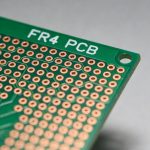
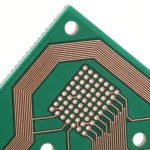
Selecting a PCB material is not simply choosing a board that meets the required thickness.
Every laminate has its own electrical, mechanical and thermal characteristics. These properties influence signal transmission, heat dissipation, dimensional stability and long-term reliability.
FR4 has become the standard substrate for most printed circuit boards because it offers a balanced performance across these areas while remaining cost-effective.
Why Material Properties Matter
Many PCB issues are not caused by routing or assembly.
Unexpected signal loss, board warpage, poor thermal performance or reduced reliability often relate to the material itself.
Before selecting a laminate, engineers usually evaluate:
- electrical performance
- thermal stability
- mechanical strength
- moisture resistance
- manufacturing compatibility
Looking at these properties together provides a clearer picture than focusing on a single specification.
Dielectric Constant
The dielectric constant (Dk) describes how a material stores electrical energy.
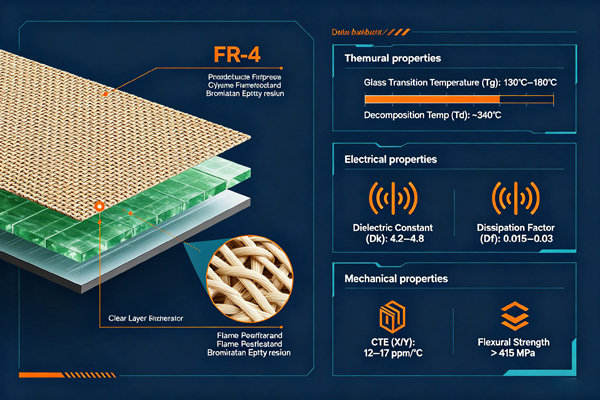
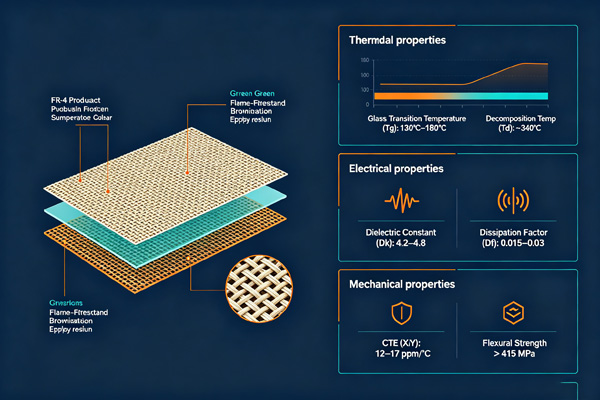
For standard FR4, the dielectric constant typically falls between 4.2 and 4.8, depending on the resin system, glass style and test frequency.
The dielectric constant influences:
- signal propagation
- impedance calculation
- trace dimensions
- timing consistency
As operating frequency increases, the effective dielectric constant may change slightly.
Related reading:
FR4 Dielectric Constant (Er) vs Frequency Explained
Dielectric Loss
Dielectric loss measures how much signal energy is converted into heat while travelling through the laminate.
For low-speed digital products, this has little practical impact.
For high-speed or RF circuits, however, excessive dielectric loss can reduce signal quality over long transmission distances.
This is one reason why materials with lower loss characteristics are often selected for microwave and high-frequency applications.
Related reading:
Glass Transition Temperature
Glass transition temperature (Tg) indicates the point at which the resin begins to soften rather than remaining rigid.
A higher Tg generally improves dimensional stability during repeated thermal cycles.
Products operating at elevated temperatures or experiencing multiple lead-free soldering processes often benefit from High-Tg laminates.
Standard FR4 remains suitable for many commercial and industrial products that operate within normal temperature ranges.
Related reading: FR4 PCB vs High-Tg FR4
Thermal Conductivity
Thermal conductivity describes how efficiently heat moves through the substrate.
Standard FR4 has relatively low thermal conductivity compared with materials such as aluminum-core or ceramic laminates.
For designs with moderate power consumption, this is rarely a concern.
For products that generate significant heat, thermal management often depends on additional measures such as copper planes, thermal vias or external heat sinks.
The laminate itself is only one part of the overall cooling strategy.
Moisture Absorption
Even though FR4 has good moisture resistance, it is not completely waterproof.
When exposed to humid environments over long periods, the laminate can absorb a small amount of moisture.
Excessive moisture may influence:
- insulation performance
- dimensional stability
- soldering reliability
Proper storage before assembly helps reduce moisture-related issues.
Mechanical Strength
The woven fiberglass reinforcement provides FR4 with excellent rigidity.
This makes it suitable for products that must withstand:
- vibration
- handling during assembly
- repeated connector insertion
- transportation
Mechanical stability is one of the reasons FR4 remains the preferred material for rigid PCBs.
Electrical Insulation
FR4 offers high insulation resistance between conductive layers.
This characteristic allows multilayer boards to maintain reliable isolation while supporting dense routing.
Combined with proper stackup design, the material provides stable electrical performance for a wide range of applications.
Related reading:
FR4 PCB Stackup Design Guide
Flame Retardant Performance
Safety is another important property.
Standard FR4 materials are commonly manufactured to meet the UL94 V-0 flame-retardant rating.
This means the material is designed to self-extinguish after the ignition source is removed, helping reduce fire risk in electronic products.
Dimensional Stability
A PCB expands and contracts slightly as temperature changes.
FR4 maintains good dimensional stability during normal operating conditions, allowing multilayer registration and component alignment to remain consistent throughout manufacturing.
Stable dimensions are particularly important for fine-pitch components and multilayer boards.
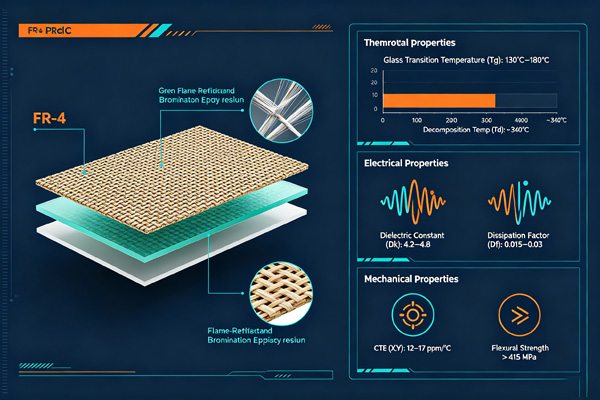
Balancing Performance and Cost
No PCB material excels in every category.
FR4 continues to dominate the market because it balances:
- electrical performance
- mechanical strength
- thermal stability
- manufacturing efficiency
- material cost
For many commercial products, this balance is more valuable than maximizing a single property.
Only when the application places exceptional demands on temperature, frequency or power does another laminate become the better choice.
How to Evaluate FR4 Material Properties
- Step 1
Define the electrical requirements of the product, including operating frequency and signal performance.
- Step 2
Assess the thermal environment, considering both ambient temperature and heat generated during operation.
- Step 3
Review the expected mechanical conditions, such as vibration, shock or repeated handling.
- Step 4
Compare the material properties with the application requirements before selecting the laminate.
Choosing a PCB material based on actual operating conditions is generally more reliable than selecting it by cost alone.
Conclusion
FR4 remains the industry’s preferred PCB substrate because it provides a practical balance of electrical, thermal and mechanical performance.
Rather than focusing on a single specification, engineers should evaluate the complete set of material properties and consider how they relate to the intended application.
A well-matched laminate improves manufacturability, product reliability and long-term performance without introducing unnecessary cost.
Frequently Asked Questions
A: The key properties include dielectric constant, dielectric loss, glass transition temperature, thermal conductivity, moisture absorption and mechanical strength.
A: No. Different manufacturers use different resin systems and fiberglass constructions, so electrical and thermal characteristics can vary.
A: It affects signal propagation speed, impedance control and PCB layout dimensions, particularly in high-speed circuits.
A: It is suitable for many commercial products, but applications exposed to sustained high temperatures often benefit from High-Tg FR4.
A: Because it offers a reliable balance of performance, manufacturability and cost across a wide range of electronic products.