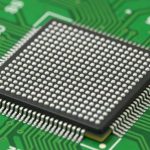
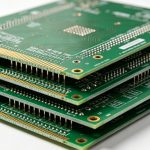
When preparing a printed circuit board (PCB) for manufacturing, one of the most critical decisions you will make is choosing the right assembly technology. The two primary methods—Surface Mount Technology (SMT) and Through-Hole Technology (THT)—represent different eras of engineering, each with its own distinct advantages.
At HanSphere, we run advanced automated lines for both technologies. In this guide, we will break down the differences between SMT and THT regarding cost, performance, and durability to help you make the right choice for your product.
1. Defining the Technologies
What is SMT (Surface Mount Technology)?
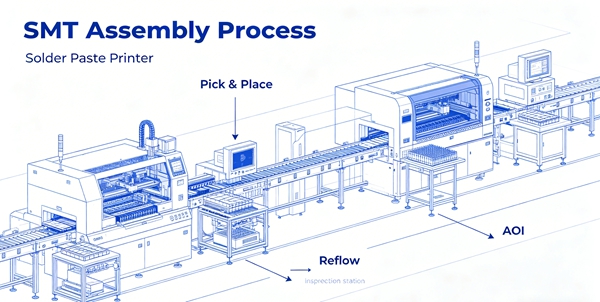
SMT is the modern standard for electronics assembly. Components (SMDs) are placed directly onto the surface of the PCB copper pads using automated pick-and-place machines, and then secured via reflow soldering.
What is THT (Through-Hole Technology)?
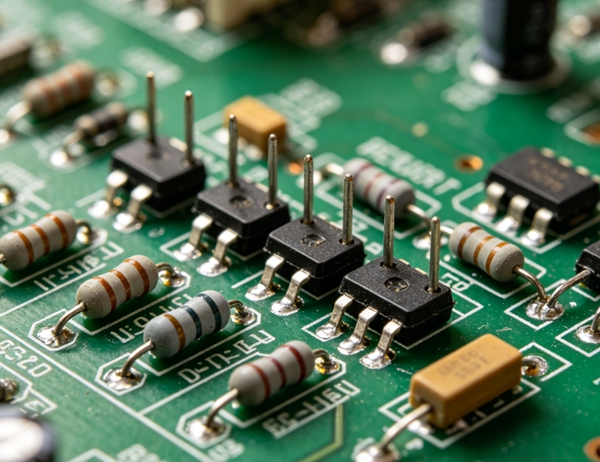
THT is the traditional mounting method. Component leads are inserted into pre-drilled, plated holes in the PCB and soldered on the opposite side, typically using a wave soldering or selective soldering machine.
2. Head-to-Head Comparison
To help your engineering and procurement teams align, let’s look at how these two methods compare across key metrics:
| Feature | SMT (Surface Mount) | THT (Through-Hole) |
| Component Size | Ultra-small (down to 01005) | Larger, bulkier components |
| Assembly Speed | Extremely High (Automated) | Slower (Often Semi-Automated/Manual) |
| Mechanical Strength | Moderate (Relies on surface solder) | High (Leads pass through the board) |
| Board Space Efficiency | High (Supports double-sided placement) | Low (Holes occupy space on all layers) |
| Prototyping/Debugging | Difficult (Requires specialized tools) | Easy (Breadboard and hand-solder friendly) |
| Ideal For | High-density, high-speed digital electronics | Power supplies, industrial controllers, connectors |
3. When to Choose SMT
SMT is the undisputed choice for 90% of modern consumer electronics. You should design for SMT if your project requires:
- Miniaturization: If you are building wearables, IoT devices, or smartphones, SMT allows components to be tightly packed.
- High-Speed Signals: SMT components have shorter leads or no leads at all (like BGAs). This drastically reduces parasitic capacitance and inductance, which is essential for high-frequency RF and high-speed data circuits.
- Mass Production Economy: Because SMT lines are fully automated, the labor cost per board drops significantly during high-volume production runs.
4. When to Choose THT
Despite the dominance of SMT, THT remains irreplaceable for rugged, industrial hardware. Choose THT for:
- Extreme Mechanical Stress: Connectors, switches, and interfaces that human hands pull, push, or twist need the physical reinforcement of through-hole anchors to prevent the pads from tearing off the board.
- High Voltage and Power Handling: Large transformers, power transistors, and heavy electrolytic capacitors generate significant heat and require robust physical contacts to handle high currents safely.
- Harsh Environments: If your product will be exposed to extreme vibrations (such as automotive or aerospace systems) or rapid thermal cycling, THT joints provide a more stable bond over time.
5. The Modern Solution: Mixed/Hybrid Assembly
In the real world, you rarely have to choose just one. Most complex PCBs designed at HanSphere are Hybrid Boards.
Our factory engineers regularly set up production lines where the digital brain of the device (MCU, sensors, memory) is assembled via ultra-fast SMT lines first. Then, the heavy power inputs and user-facing ports are populated using precise automated selective wave soldering. This approach optimizes both cost and performance.
Internal Link: Ready to plan your layout? Read our Design for Manufacturing (DFM) Guide to ensure your hybrid design is production-ready.
FAQ: SMT vs. THT Insights
A: Yes. However, from a manufacturing standpoint, it is best to place all SMT components on one side (or both) and THT components on the top side. This setup minimizes the number of factory line setups and lowers your total PCBA costs.
A: Absolutely. We apply Automated Optical Inspection (AOI) to SMT arrays and use a combination of automated systems and manual inspection for THT components to ensure zero-defect solder joints.
A: Simply label the package types clearly (e.g., “0603” for SMT or “Thru-Hole P=2.54mm” for THT). Our sourcing team will classify them automatically for production.