Most engineers work with FR4 every day, yet few consider how the material itself is produced before it becomes a printed circuit board.
The manufacturing process determines many of the laminate’s final properties, including mechanical strength, dimensional stability, moisture resistance, and electrical performance.
Although different laminate suppliers use proprietary resin systems and production techniques, the basic manufacturing process is similar across the industry.

FR4 Starts with Two Raw Materials
FR4 is made by combining woven fiberglass cloth with epoxy resin.
Each material performs a different function.
The fiberglass provides structural strength and dimensional stability.
The epoxy resin binds the fiberglass together while providing electrical insulation and flame-retardant characteristics.
Neither material alone can meet the requirements of modern PCB manufacturing.
Producing the Fiberglass Cloth
The process begins by melting glass into extremely fine continuous filaments.
These fibers are woven into different fabric styles depending on the required mechanical properties.
The weave pattern influences:
- thickness consistency
- resin distribution
- dimensional stability
- electrical uniformity
Different glass styles are selected for different laminate constructions.
Resin Impregnation
The woven fiberglass passes through liquid epoxy resin.
The resin fills the spaces between the glass fibers and coats the fabric uniformly.
After impregnation, the material is partially cured to create what is known as prepreg.
Prepreg remains flexible enough for later lamination while containing the correct amount of resin for the finished laminate.
Building the Laminate
Multiple prepreg sheets are stacked together according to the required laminate thickness.
Copper foil is placed on one or both sides of the stack.
The complete assembly is then transferred to a lamination press.
Heat and Pressure Lamination
Inside the press, controlled heat and pressure permanently bond the fiberglass, epoxy resin, and copper foil into a single rigid panel.
During this stage, the resin flows evenly through the fiberglass layers before fully curing.
Proper control of temperature, pressure, and curing time is essential for achieving consistent laminate quality.
Surface Finishing
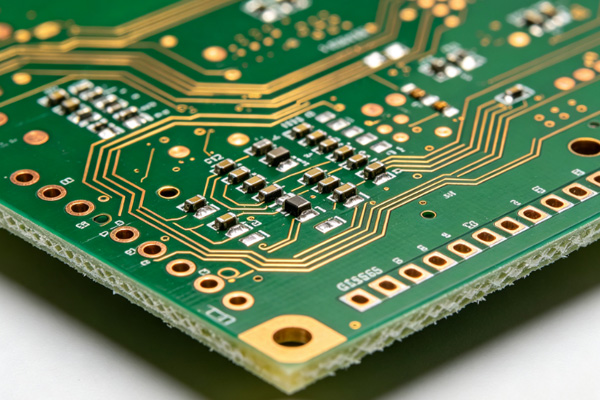
After lamination, the panels are trimmed and prepared for PCB manufacturing.
The copper surface is cleaned to improve adhesion during later imaging and etching processes.
Manufacturers also inspect the laminate for:
- thickness consistency
- surface defects
- resin voids
- dimensional accuracy
Only panels meeting specification proceed to PCB fabrication.
Quality Control During Manufacturing
Laminate manufacturers perform a range of tests before shipping FR4 materials.
Typical inspections include:
- thickness measurement
- glass transition temperature (Tg)
- dielectric constant
- moisture absorption
- peel strength
- flame-retardant verification
These tests help ensure the laminate meets published material specifications.
Related reading:
- FR4 Material Properties That Affect PCB Performance
- FR4 Moisture Absorption and Its Impact on PCB Reliability
Why Manufacturing Quality Matters
Two laminates may both be classified as FR4 while performing differently in production.
Variations in resin formulation, fiberglass quality, curing conditions, and process control can affect:
- drilling quality
- dimensional stability
- thermal reliability
- electrical consistency
For applications with higher reliability requirements, material quality becomes increasingly important.
How to Evaluate FR4 Laminate Quality
- Step 1
Review the laminate manufacturer’s technical data sheet.
- Step 2
Confirm the required Tg, dielectric constant, and thickness tolerance.
- Step 3
Verify compliance with applicable standards and certifications.
- Step 4
Work with a PCB manufacturer that sources laminates from qualified suppliers.
Conclusion
The performance of FR4 begins long before PCB fabrication starts.
Carefully controlled fiberglass production, resin impregnation, lamination, and quality inspection all contribute to the reliability of the finished material.
Understanding how FR4 is manufactured makes it easier to evaluate material quality and select the right laminate for different electronic applications.
Frequently Asked Questions
A: FR4 is manufactured from woven fiberglass cloth and flame-retardant epoxy resin, laminated together with copper foil.
A: Prepreg is fiberglass cloth impregnated with partially cured epoxy resin. It is used to build the laminate during the lamination process.
A: Lamination permanently bonds the fiberglass, resin, and copper foil into a rigid PCB substrate while ensuring uniform thickness and material properties.
A: The basic process is similar, but resin formulations, fiberglass styles, curing conditions, and quality control methods vary between manufacturers.
A: Yes. Laminate quality can influence mechanical strength, electrical performance, moisture resistance, and long-term reliability.