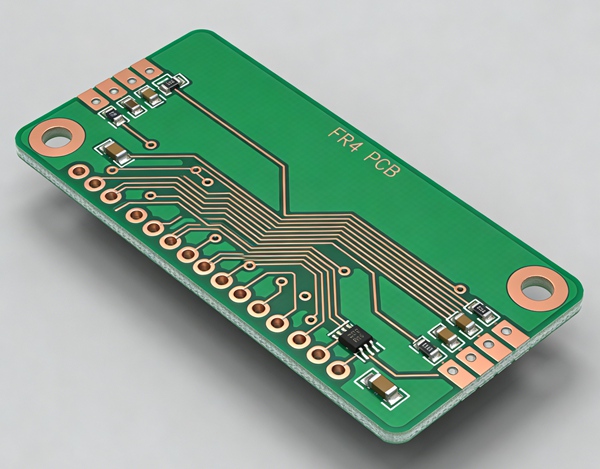
If you open almost any electronic product, there is a good chance the circuit board inside is made from FR4.
From consumer electronics to industrial controllers, FR4 has been the standard PCB substrate for decades. It offers reliable mechanical strength, consistent electrical performance, and a manufacturing cost that fits most commercial applications.
That does not mean FR4 is the right material for every project.
As operating frequencies increase and thermal requirements become more demanding, engineers often need to evaluate whether standard FR4 can still meet the design goals.
Understanding the strengths and limitations of FR4 is the first step toward choosing the right PCB material.
What FR4 PCB Material Is
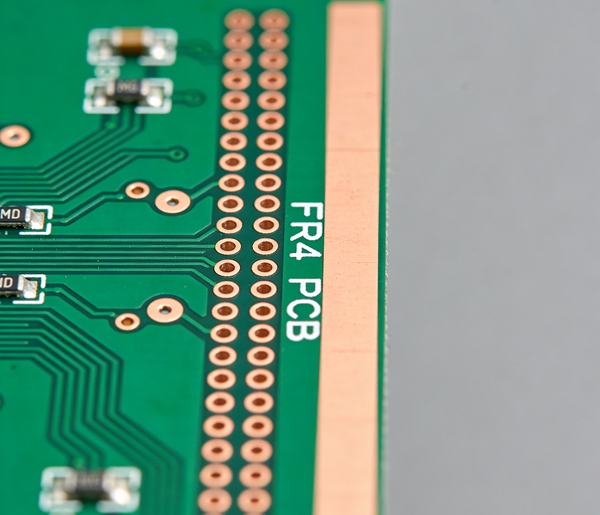
FR4 is a flame-retardant composite material made from woven fiberglass cloth and epoxy resin.
The name comes from the NEMA (National Electrical Manufacturers Association) designation:
- FR stands for Flame Retardant
- 4 identifies a specific grade of fiberglass-reinforced epoxy laminate
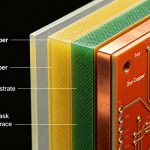
After the fiberglass cloth is impregnated with epoxy resin, multiple sheets are laminated together under heat and pressure to form a rigid substrate. Copper foil is then bonded to one or both sides, creating the base material used for PCB fabrication.
Because of its balance between performance and cost, FR4 has become the default material for most printed circuit boards.
Why FR4 Is Widely Used
FR4 remains popular because it performs well across a wide range of applications without significantly increasing manufacturing cost.
Compared with many specialty materials, FR4 offers:
- good mechanical strength
- reliable electrical insulation
- stable dimensional performance
- compatibility with standard PCB manufacturing processes
- broad availability across different thicknesses and copper weights
For many industrial and commercial products, these characteristics are sufficient to achieve reliable long-term performance.
Key Properties of FR4
Selecting a PCB material begins with understanding its physical and electrical characteristics.
Mechanical Strength
The woven glass fiber reinforcement gives FR4 excellent rigidity.
It resists bending, vibration, and mechanical stress better than many flexible substrate materials, making it suitable for products that require structural stability.
Electrical Insulation
FR4 provides strong electrical isolation between conductive copper layers.
This allows multilayer PCBs to maintain reliable insulation even in compact layouts.
For designs requiring controlled impedance, material consistency is just as important as trace geometry.
Related reading: FR4 PCB Stackup Design Guide
Thermal Performance
Standard FR4 can withstand normal soldering temperatures used during PCB assembly.
However, prolonged exposure to high operating temperatures may gradually reduce its mechanical and electrical performance.
Applications involving continuous high temperatures often require High-Tg materials.
Related reading: FR4 PCB vs High-Tg FR4
Flame Resistance
One of the defining characteristics of FR4 is its flame-retardant capability.
The material is formulated to slow the spread of flame after the ignition source is removed, helping products meet common safety requirements.
Typical FR4 Material Specifications
Although different laminate suppliers provide slightly different formulations, standard FR4 materials generally fall within similar performance ranges.
Typical properties include:
| Property | Typical Value |
|---|---|
| Dielectric Constant (1 GHz) | 4.2–4.8 |
| Glass Transition Temperature (Standard FR4) | 130–140°C |
| Thermal Conductivity | Approximately 0.3 W/m·K |
| Volume Resistivity | Very High |
| Water Absorption | Low |
| Flame Rating | UL94 V-0 |
Actual values depend on the laminate manufacturer and product grade.

Common PCB Applications Using FR4
FR4 is suitable for a wide variety of electronic products.
Typical applications include:
- industrial control systems
- consumer electronics
- communication equipment
- power supplies
- medical devices
- automotive electronics with moderate thermal requirements
As board complexity increases, FR4 is also commonly used in multilayer PCB designs.
When Standard FR4 May Not Be the Best Choice
Although FR4 is versatile, every material has practical limits.
High-Frequency Designs
As operating frequency increases, dielectric loss becomes more significant.
Applications such as RF communication, microwave circuits, and radar systems often require lower-loss materials.
Related reading:
High Operating Temperatures
Products exposed to continuous thermal stress may benefit from High-Tg FR4 or ceramic substrates.
Examples include:
- industrial power electronics
- automotive engine control
- LED power modules
Thermal Management
FR4 has relatively low thermal conductivity.
Designs generating significant heat often use alternative materials such as aluminum-core or ceramic PCBs to improve heat dissipation.
How FR4 Affects PCB Manufacturing
FR4 has become the industry standard partly because it works well with established manufacturing processes.
It supports:
- multilayer lamination
- mechanical drilling
- laser drilling for selected constructions
- through-hole plating
- surface finish processes including ENIG, HASL, and OSP
Its widespread use also helps reduce manufacturing cost because material availability is rarely a concern.
How FR4 Influences PCB Cost
Material cost is only one part of the overall manufacturing budget.
FR4 remains economical because:
- raw materials are readily available
- fabrication processes are mature
- manufacturers maintain stable supply chains
- processing yield is generally high
For many commercial products, choosing FR4 provides the best balance between performance and production cost.
How to Select the Right FR4 Material
Choosing FR4 involves more than selecting board thickness.
- Step 1
Define the operating environment.
Consider:
. working temperature
. humidity
. mechanical stress - Step 2
Evaluate electrical requirements.
Review:
. operating frequency
. impedance control
. signal integrity requirements
Related reading: FR4 Dielectric Constant (Er) vs Frequency Explained - Step 3
Review manufacturing requirements.
Confirm:
. layer count
. copper thickness
. minimum trace width
. assembly process - Step 4
Compare FR4 with alternative materials if necessary.
High-frequency or high-temperature products may benefit from other laminate systems rather than standard FR4.
Common Misunderstandings About FR4
Several misconceptions appear frequently during material selection.
One is assuming that all FR4 laminates are identical.
In reality, laminate manufacturers offer different resin systems, glass styles, and Tg ratings, all of which influence performance.
Another misconception is that FR4 cannot be used for high-speed designs.
Many high-speed digital products successfully use carefully selected FR4 materials when stackup, impedance, and routing are properly controlled.
The material alone does not determine PCB performance.
Conclusion
FR4 continues to be the most widely used PCB substrate because it delivers a practical balance between electrical performance, mechanical strength, manufacturability, and cost.
While advanced applications may require specialty laminates, standard FR4 remains the preferred choice for most commercial and industrial electronics.
Selecting the right material should always be based on the product’s electrical, thermal, and mechanical requirements rather than assuming one substrate is suitable for every design.
Frequently Asked Questions
A: FR4 stands for Flame Retardant Grade 4, referring to a fiberglass-reinforced epoxy laminate with flame-resistant properties.
A: It offers a good balance of electrical performance, mechanical strength, manufacturability, and cost, making it suitable for most electronic products.
A: FR4 can be used for many high-speed digital circuits, but RF and microwave applications often require lower-loss materials such as Rogers laminates.
A: Yes. Standard FR4 is compatible with common PCB assembly processes, although high-temperature applications may benefit from High-Tg FR4 materials.
A: No. Different manufacturers provide FR4 laminates with different glass transition temperatures, dielectric properties, and resin formulations, so material specifications should always be reviewed during PCB design.