Once a PCB goes beyond simple circuits, single or double layers are no longer enough.
Signals start to interfere with each other.
Power distribution becomes unstable.
Routing space becomes limited.
That’s when multilayer PCBs become necessary.
A multilayer PCB is not just “more layers stacked together”.
It is a structured electrical system designed to control signal flow, return paths, and power distribution.
What Is a Multilayer PCB?
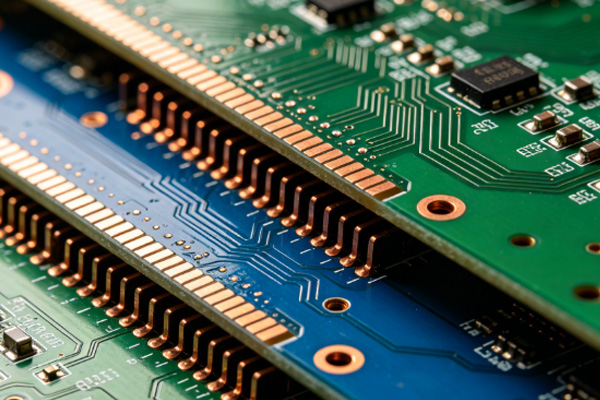
A multilayer PCB consists of three or more conductive copper layers separated by insulating material.
Unlike simple boards, multilayer designs allow:
- higher routing density
- better signal integrity
- controlled impedance
- stable power distribution
In practice, most modern electronics use multilayer structures as a baseline.
Why Use Multilayer PCBs?
As circuit complexity increases, single-layer routing creates problems:
- long signal paths
- routing congestion
- unstable ground reference
- higher EMI risk
Multilayer boards solve these issues by separating functions across layers.
Typical separation:
- signal layers
- ground planes
- power planes
This separation is what makes high-speed design possible.
Common Multilayer PCB Stackups
Different layer counts serve different design needs.
4-Layer PCB
Typical structure:
- Signal
- Ground
- Power
- Signal
Characteristics
- basic signal integrity improvement
- suitable for mid-speed designs
- widely used in consumer electronics
Limitations
- limited routing space
- fewer grounding options
- less flexibility for high-speed signals
6-Layer PCB
A common structure:
- Signal
- Ground
- Signal
- Signal / Power
- Ground
- Signal
Characteristics
- better return path control
- improved EMI performance
- more stable routing environment
This is often a transition point for higher-speed designs.
Related concept: FR4 PCB Stackup Design Guide
8-Layer PCB
Typical structure:
- Signal
- Ground
- Signal
- Power
- Ground
- Signal
- Ground
- Signal
Characteristics
- strong signal isolation
- better impedance stability
- improved high-speed routing flexibility
At this level, signal integrity becomes significantly easier to manage.
Related: Controlled Impedance PCB Design
How Layer Count Affects PCB Performance
Layer count is not just about routing space.
It directly impacts:
1. Signal Integrity
More internal reference planes improve:
- return path consistency
- noise reduction
- signal stability
Poor stackup design often causes more issues than routing itself.
Related: PCB Insertion Loss Explained
2. Power Distribution
Multilayer boards allow dedicated power planes.
Benefits:
- lower impedance power delivery
- reduced voltage drop
- improved stability under load
This is closely tied to system reliability.
Related: PCB Power Integrity Design
3. EMI Performance
Proper layer arrangement helps reduce:
- radiation
- coupling
- external interference
Ground planes act as shielding layers.
4. Routing Density
More layers allow:
- shorter trace lengths
- fewer vias
- cleaner routing channels
This improves both performance and manufacturability.
Key Design Considerations for Multilayer PCBs
1. Stackup Planning Comes First
Stackup defines everything:
- impedance behavior
- return path structure
- signal layer placement
Once defined, routing must follow it.
2. Reference Plane Consistency
Signal layers should always have a nearby reference plane.
Without it:
- return current paths become unpredictable
- noise increases
This is one of the most common design mistakes.
3. Via Strategy Matters
Every layer transition introduces discontinuity.
Poor via design leads to:
- signal reflection
- impedance mismatch
- added loss
Related: PCB Via Design in High-Speed Circuits
4. Manufacturing Constraints
Multilayer boards require tighter control over:
- layer alignment
- dielectric thickness
- copper balancing
This directly affects yield and cost.
5. Design for Manufacturability
A good design is not only functional—it must be producible.
Poor manufacturability leads to:
- lower yield
- higher cost
- inconsistent performance
Related: High-Speed PCB Design for Manufacturing & Yield
Common Mistakes in Multilayer PCB Design
From real production experience, common issues include:
- stackup defined too late
- signals crossing split planes
- missing reference ground layers
- excessive via transitions
- ignoring return current paths
Most of these issues are avoidable at the design stage.
Multilayer PCB in Real Applications
Multilayer designs are commonly used in:
- communication devices
- industrial controllers
- computing systems
- high-speed digital boards
As performance requirements increase, multilayer structure becomes the default choice.
Conclusion
Multilayer PCBs are essential for modern electronics where signal integrity, power stability, and routing density must be controlled simultaneously.
The key to successful multilayer design is not just adding layers, but designing a proper stackup with correct signal and reference plane relationships.
Once stackup is well defined, routing, impedance control, and manufacturing become significantly more predictable.
FAQ
A: A multilayer PCB is a circuit board with three or more copper layers separated by insulating material.
A: They provide better routing density, signal integrity, and power distribution.A:
A: Common examples include 4-layer, 6-layer, and 8-layer structures with signal, ground, and power layers.
A: Not always. Layer count should balance performance, cost, and manufacturing complexity.
A: Stackup planning and maintaining proper reference planes for signal integrity.