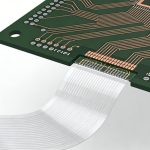
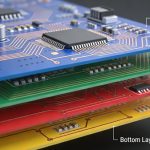
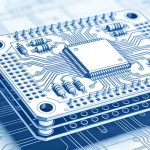
Drilling is one of the most precise operations in PCB manufacturing. Every plated through hole, mounting hole, and via begins at this stage.
The position and quality of each hole affect not only component assembly but also electrical connectivity between PCB layers. On multilayer boards, even a small drilling error can lead to registration problems or unreliable interlayer connections.
Modern PCB factories rely on CNC drilling equipment to achieve the accuracy required for today’s increasingly compact electronic products.
Use up and down arrow keys to resize the meta box pane.
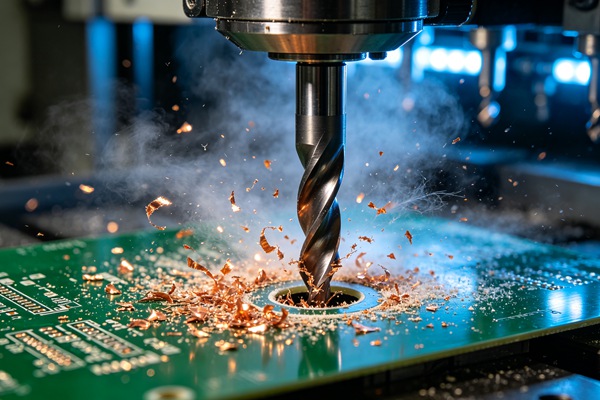
What Is PCB Drilling?
PCB drilling is the process of creating holes in the circuit board before plating and final assembly.
These holes are used for different purposes, including:
- Plated through holes (PTH)
- Vias
- Component lead holes
- Mounting holes
- Mechanical positioning holes
Once drilling is complete, many of these holes are metallized to create electrical connections between copper layers.
Before drilling begins, the board has already gone through material preparation and copper lamination. If you’re interested in those stages, PCB Laminate Explained for PCB Design and Manufacturing provides an overview of the base material used in PCB fabrication.
Common Types of PCB Holes
Not every hole on a PCB serves the same purpose.
Plated Through Holes
Plated through holes connect copper layers electrically while also supporting through-hole components.
They are commonly used in industrial equipment, power electronics, and connectors.
Vias
Vias provide electrical connections between different PCB layers without accommodating component leads.
They are widely used in multilayer PCB designs to improve routing flexibility.
Non-Plated Through Holes
These holes are not electrically conductive.
Typical applications include:
- Mounting screws
- Alignment pins
- Mechanical fixtures
How the PCB Drilling Process Works
Although manufacturing equipment varies, the basic workflow is similar.
Panel Alignment
The PCB panel is accurately positioned before drilling begins.
Registration accuracy is critical, especially for multilayer boards.
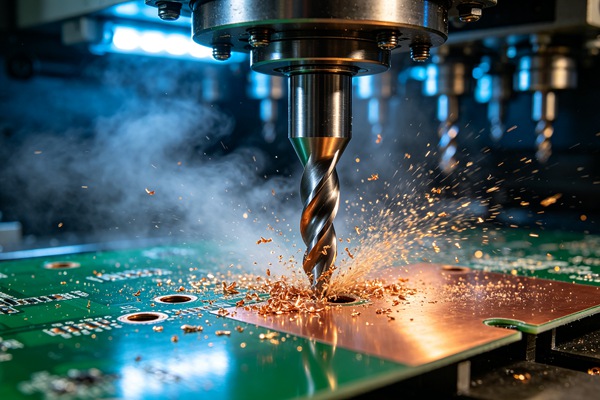
CNC Drilling
Computer-controlled drilling machines create holes according to the drill data generated from the PCB design files.
High-speed spindles allow thousands of holes to be drilled with excellent positional accuracy.
Hole Inspection
After drilling, manufacturers inspect hole diameter, location, and quality before moving to the next production step.
Hole Preparation
The hole walls are cleaned to remove resin residue before copper plating.
This preparation helps ensure reliable electrical connections during the plating process.
Mechanical Drilling and Laser Drilling
PCB manufacturers commonly use two drilling methods.
Mechanical Drilling
Mechanical drilling uses carbide drill bits.
It remains the preferred method for:
- Through holes
- Mounting holes
- Standard vias
It offers high accuracy and is suitable for most PCB designs.
Laser Drilling
Laser drilling is mainly used for very small holes, particularly microvias in HDI boards.
Compared with mechanical drilling, laser drilling can produce much smaller hole diameters and is well suited to high-density interconnect technology.
Factors That Affect Drilling Quality
Several variables influence the quality of drilled holes.
Drill Bit Condition
Worn drill bits can increase burrs, reduce hole accuracy, and affect plating quality.
Material Properties
Different PCB materials respond differently to drilling.
For example, laminate composition and resin systems influence hole quality and tool wear.
If you’d like to understand these materials in more detail, What Is FR4 PCB Material explains the characteristics of the industry’s most widely used substrate.
Board Thickness
Thicker multilayer boards require tighter drilling control to maintain hole accuracy throughout the full depth of the board.
Hole Size
Very small holes demand greater manufacturing precision and specialized equipment.
Common Drilling Defects
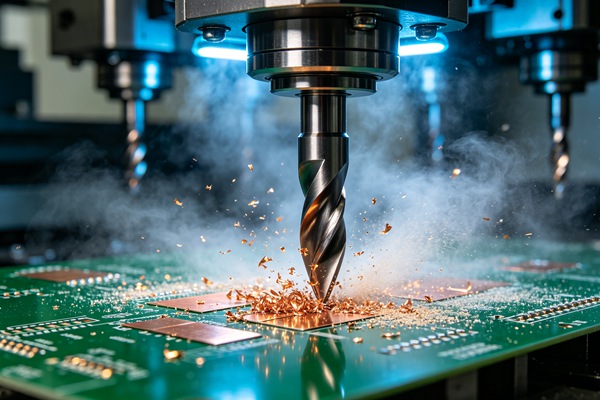
Quality control focuses on preventing issues such as:
- Burrs around hole edges
- Hole position deviation
- Resin smear
- Broken drill bits
- Incorrect hole diameter
Consistent equipment maintenance and process control help minimize these defects.
Why Drilling Accuracy Matters
Accurate drilling supports several aspects of PCB quality.
- Reliable electrical connections
- Correct component placement
- Stable multilayer registration
- Better plating quality
- Improved long-term reliability
As PCB designs become denser, drilling accuracy becomes even more important.
How to Improve PCB Drilling Quality
- Step 1
Choose hole sizes that match your PCB manufacturer’s manufacturing capabilities.
- Step 2
Maintain reasonable spacing between holes and copper features during PCB layout.
- Step 3
Select suitable PCB materials and board thickness for the application.
- Step 4
Review drill files and manufacturing requirements before production begins.
Conclusion
PCB drilling creates the foundation for electrical interconnections and mechanical assembly.
Accurate hole positioning, proper drilling methods, and effective quality control all contribute to reliable PCB performance. Whether producing a simple double-sided board or a complex multilayer design, careful drilling remains an essential part of the manufacturing process.
Frequently Asked Questions
A: PCB drilling is the process of creating holes for electrical connections, component leads, and mechanical mounting before plating and assembly.
A: A via is primarily used to connect PCB layers electrically, while a plated through hole can also accommodate through-hole components.
A: Laser drilling is commonly used for microvias in HDI PCBs where extremely small hole sizes are required.
A: Cleaning removes resin residue from the hole walls, helping copper plating adhere properly and improving electrical reliability.
A: Drill bit condition, board material, hole diameter, board thickness, and machine calibration all influence drilling quality.