Electronic products rarely operate at a constant temperature. A PCB may heat up during normal use, cool down after power is removed, and repeat this cycle thousands of times over its service life.
Every heating and cooling cycle causes the materials inside the board to expand and contract. How much they move depends on a material property known as the coefficient of thermal expansion, or CTE.
Although CTE is often overlooked during material selection, it plays an important role in the reliability of multilayer PCBs, plated through holes, and solder joints.
What Is the Coefficient of Thermal Expansion?
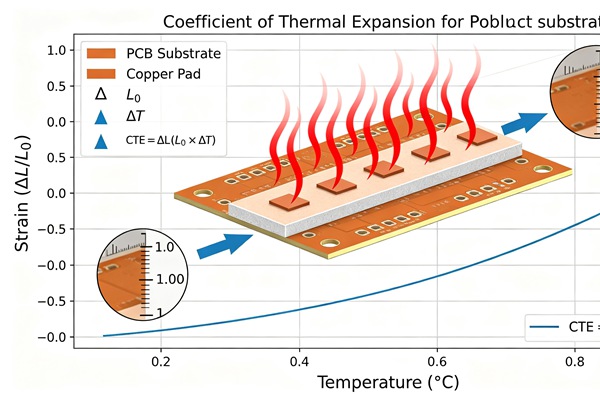
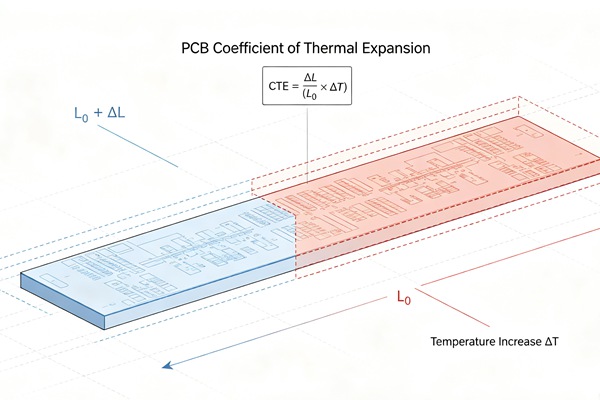
The coefficient of thermal expansion describes how much a material changes in size when its temperature changes.
For PCB laminates, CTE is usually expressed in parts per million per degree Celsius (ppm/°C).
A lower CTE means the material expands less as temperature rises.
A higher CTE means greater dimensional change under the same conditions.
Because a PCB is made from different materials—including copper, fiberglass, and resin—the expansion of each material is not identical.
Why CTE Matters in PCB Design
Expansion and contraction are normal, but problems occur when different materials expand at different rates.
Over time, this mismatch can place stress on the board and its interconnections.
CTE has a direct influence on:
- plated through-hole reliability
- solder joint durability
- multilayer registration
- dimensional stability
- thermal cycling performance
For products expected to operate in demanding environments, CTE should be considered together with other material properties.
CTE in Different Directions
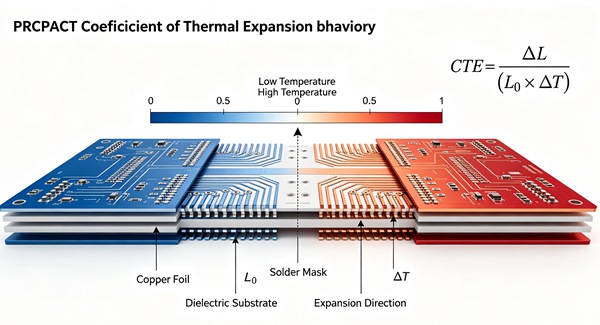
PCB laminates do not expand equally in every direction.
Manufacturers usually specify:
X-axis CTE
Expansion along the length of the board.
Y-axis CTE
Expansion across the width of the board.
Z-axis CTE
Expansion through the thickness of the board.
Among these, Z-axis expansion is often the most important because it directly affects plated through holes and multilayer structures.
How Tg and CTE Are Related
CTE and glass transition temperature (Tg) are closely connected.
Below the material’s Tg, expansion is relatively stable.
Once the temperature exceeds Tg, the resin becomes more flexible and expansion increases.
This is one reason why materials with a higher Tg are often selected for products that experience repeated heating during manufacturing or operation.
If you’re unfamiliar with Tg, PCB Glass Transition Temperature Explained provides a detailed overview.
Why CTE Is Important in Multilayer PCBs
As the number of PCB layers increases, dimensional stability becomes more critical.
Excessive expansion can contribute to:
- stress around vias
- barrel cracking
- layer misalignment
- reduced long-term reliability
Careful material selection helps reduce these risks.
The relationship between laminate construction and layer stability is also discussed in PCB Laminate Explained for PCB Design and Manufacturing.
Typical CTE Values
Exact values vary between manufacturers and material systems, but the general trend is:
| Material | Relative CTE |
|---|---|
| Standard FR4 | Moderate |
| High-Tg FR4 | Lower than standard FR4 |
| Polyimide | Low |
| Ceramic | Very low |
| PTFE | Higher than many epoxy materials |
Manufacturer datasheets should always be used when confirming material properties for a specific design.
Does Lower CTE Always Mean Better?
Not necessarily.
Lower CTE improves dimensional stability, but it is only one factor in material selection.
Other considerations include:
- dielectric properties
- thermal conductivity
- moisture resistance
- manufacturing cost
- mechanical requirements
Choosing the right laminate means balancing all of these factors rather than optimizing only one specification.
A broader comparison of common materials is available in PCB Material Types Used in Modern Printed Circuit Boards.
Common Applications That Benefit from Low CTE
Materials with lower CTE are commonly selected for:
- automotive electronics
- industrial control systems
- aerospace equipment
- telecommunications hardware
- high-layer-count PCBs
- products exposed to repeated thermal cycling
For many consumer products, standard FR4 continues to provide reliable performance when matched to the application.
How to Evaluate CTE During Material Selection
- Step 1
Identify the highest assembly and operating temperatures the PCB will experience.
- Step 2
Review the laminate manufacturer’s CTE data in all three directions, especially the Z-axis.
- Step 3
Compare CTE together with Tg, dielectric properties, and mechanical performance.
- Step 4
Confirm the material choice with your PCB manufacturer before finalizing the stackup.
Conclusion
The coefficient of thermal expansion is an important material property that affects how a PCB responds to temperature changes.
While CTE is rarely the only factor that determines material selection, understanding how different laminates expand under thermal stress can help improve long-term reliability and reduce manufacturing risks.
Evaluating CTE together with Tg, dielectric properties, and application requirements provides a more complete basis for selecting PCB materials.
Frequently Asked Questions
A: CTE, or coefficient of thermal expansion, measures how much a PCB material expands or contracts as its temperature changes.
A: Z-axis expansion affects the thickness of the board and has a direct impact on plated through-hole reliability in multilayer PCBs.
A: Not always. Lower CTE improves dimensional stability, but the best material depends on the overall electrical, thermal, mechanical, and cost requirements of the application.
A: Below the glass transition temperature (Tg), expansion is relatively stable. Above Tg, the material expands more rapidly as the resin softens.
A: High-Tg laminates, polyimide materials, and ceramic substrates generally provide lower thermal expansion than standard FR4, although exact values vary by manufacturer.